

Table of Contents
- Physical Prayer Journal vs Digital App: A Quick Comparison
- The Neuroscience of Handwriting vs Typing in Prayer
- Best Devotional Journals for Christian Women (and What to Look For)
- How to Start a Prayer Journal: A Simple First Week
- Maintaining Consistency in Daily Devotions: Habits That Hold
- Privacy, Backups, and Data Longevity: What Digital Apps Can't Promise
- Hybrid Prayer Workflows: Using Both Without the Guilt
- Conclusion
- Frequently Asked Questions
Last Updated: September 14, 2026
Physical Prayer Journal vs Digital App: A Quick Comparison
Choosing between a physical prayer journal vs digital app comes down to one question: which will you actually open tomorrow morning? This guide compares handwriting, synchronization, privacy, and long-term storage.

The short answer: a physical prayer journal wins on focus, memory, and emotional weight; a digital app wins on searchability and portability. Many women use both, that is a workflow, not a failure of discipline.
Here is the comparison at a glance.
| Feature | Physical Prayer Journal | Digital Prayer App |
|---|---|---|
| Tactile experience | Paper, pen, weight in hand | Screen and keyboard or voice-to-text |
| Searchability | Manual, by tab or date | Instant keyword search |
| Cloud synchronization | None needed | Syncs across devices |
| Data privacy | Private by default | Depends on provider encryption |
| Distraction risk | Low | High, notifications interrupt |
| Long-term storage | Lasts decades if kept dry | Depends on file formats and servers |
| Customization | Limited to the printed layout | Templates, themes, reminders |
| Cost | One-time purchase | Often subscription-based |
The Neuroscience of Handwriting vs Typing in Prayer
Writing by hand engages more of the brain than typing: forming letters links motor memory, visual processing, and language centers, so handwritten notes are recalled more easily.
For prayer, that slowness matters. Typing lets thoughts outrun attention; handwriting forces a pace that matches reflection.
research on handwriting and memory from the National Institutes of Health has examined how manual note-taking supports retention and conceptual understanding compared with keyboard input. The practical takeaway is not that typing is bad. It is that the medium shapes the mindset.
A digital app can still support deep prayer, especially with voice-to-text on a commute. But for mindfulness and retention, the pen has an edge.
Best Devotional Journals for Christian Women (and What to Look For)
The best devotional journals for Christian women share three traits: clear structure, space to write honestly, and a format you will not abandon by week three. Here is a five-minute decision process.
Step 1: Name your prayer style
- List-keeper. You track requests and answers over months, so you need a running tracker and dated entries.
- Reflector. You write a paragraph to hear yourself think, so you need blank or lightly guided space and paper that takes ink well.
- Scripture-first. You read and copy a passage before writing, so you need printed Scripture on the page.
- Low-margin. You have five minutes, often interrupted, so you need a timed or single-prompt format.
Step 2: Match the format to the style
- List-keepers: a tracker layout with dated request and answer columns, so patterns surface across a year.
- Reflectors: lay-flat binding and generous page size, because cramped pages get abandoned.
- Scripture-first readers: the passage printed in full, so reading and writing happen in one motion.
- Low-margin users: a timed structure, because a defined endpoint removes friction.
Step 3: Check the physical build before the prompts
- Binding. A journal that will not lay flat gets abandoned faster than one with imperfect prompts.
- Paper weight. Thin paper lets gel and fountain ink bleed through, ruining the back of the page.
- Page size. Larger pages suit paragraph writers; smaller pages suit portable list-keepers.
- Index or tabs. Tabbed sections reduce the cost of starting, because you are not deciding where to write.
Step 4: Choose the journal that fits the season you are in
Brandy Clark's Be Still Prayer Journal has four tabbed sections, Be Lifted Up, Lay It Down, Thy Word, and Sermons & Notes, with Scripture and attributes of God reading plans. It suits reflectors and Scripture-first readers who want structure without a rigid template.
For mothers with almost no margin, The 5-Minute Bible Study Journal for Moms breaks each session into five timed minutes: read, understand, apply, pray. The endpoint is the feature, not a compromise.

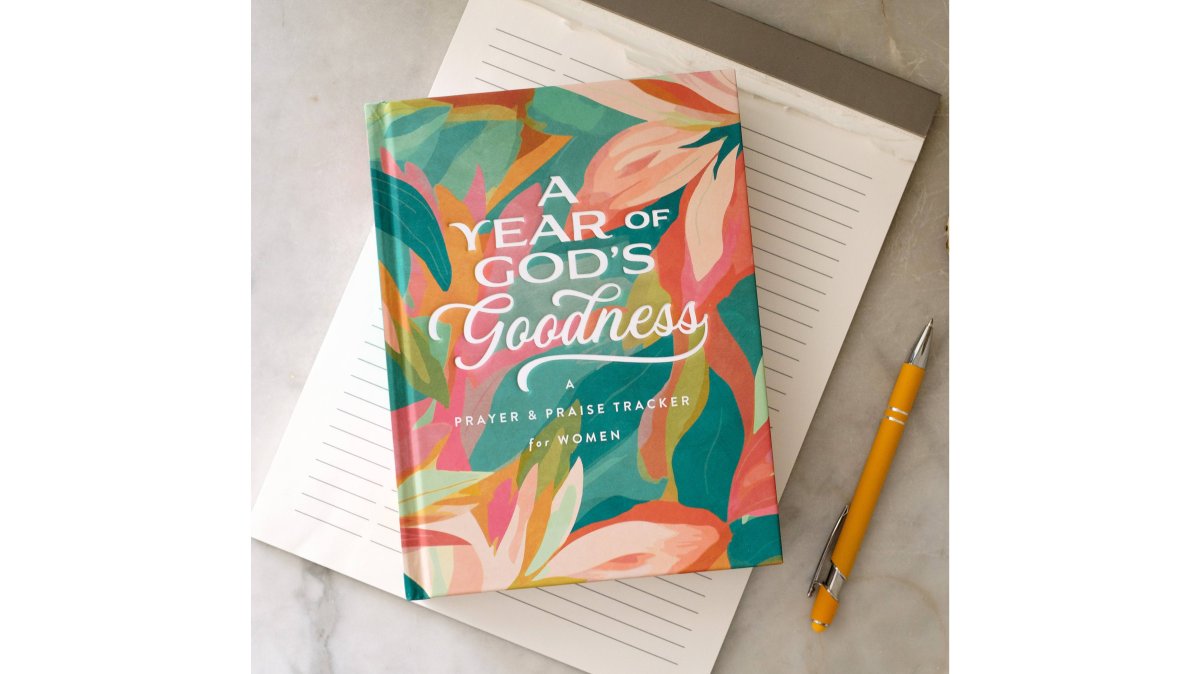
If tracking answered prayer is your priority, A Year of God's Goodness: A Prayer & Praise Tracker for Women gives a full year to record requests alongside answers, the format list-keepers keep longest.
And when words will not come, The Prayer Map: When You Don't Know What to Pray prompts you to draw your thoughts instead of writing sentences, lowering the barrier for anyone who freezes at a blank page.
What to skip
- Decorative covers with no dated structure. They photograph well and get used twice.
- Journals that reference Scripture without printing it, unless you keep a Bible open beside you.
- Any format that requires more setup than the prayer itself.
How to Start a Prayer Journal: A Simple First Week
Starting a prayer journal takes one week of small, repeatable sessions. Begin with five minutes and a single page, not an hour-long plan.

Here is a first week that works:
- Day 1: Write the date and one sentence about where you are right now.
- Day 2: Write one thing you are grateful for. Nothing more.
- Day 3: Write one request. Be specific.
- Day 4: Read one verse and copy it by hand.
- Day 5: Write one apology, then one line about grace.
- Day 6: Look back at Day 3. Note anything that has shifted.
- Day 7: Write one praise, no matter how small.
That is it. Week one is not about depth, it is habit formation and lowering the bar far enough that you return on Day 2.
Maintaining Consistency in Daily Devotions: Habits That Hold
Maintaining consistency in daily devotions depends less on willpower than on attaching prayer to something you already do. The women who keep journals for years are rarely more disciplined. They are better at anchoring.
Anchor prayer to an existing routine: the first sip of coffee, the school drop-off line, or the ten minutes before bed. Then remove friction: keep the journal open on the counter, not in a drawer, and if you use an app, put it on your home screen with notifications off except the reminder.
A few habits that hold up over time:
- Lower the minimum. A two-line entry still counts.
- Write the date every time, so you can see the pattern of God's work later.
- Keep a running praise list at the back for hard days.
- Miss a day without restarting the whole system.
guidance on habit formation from the American Psychological Association notes that small, consistent behaviors tied to existing routines are more sustainable than ambitious plans that require motivation to restart.
Privacy, Backups, and Data Longevity: What Digital Apps Can't Promise
Digital prayer apps cannot promise your entries will exist in twenty years. A paper journal can, provided it stays dry and moves with you. The real question is what happens to your entries when the app changes hands, changes formats, or shuts down.
Data longevity: the file-format problem
Every digital entry lives inside a format owned by someone else.
- Proprietary formats. Many apps store entries in a database only that app can read. If the app is discontinued, the database may be unreadable even though the file still exists on your device.
- Export limits. Some apps export to plain text or PDF; others export only to their own format. Find the export button and use it once. If you cannot find it, assume it does not exist.
- Migration loss. When an app is acquired or rebuilt, formatting, dates, and attachments are lost first. Text usually survives; structure often does not.
- Account dependency. If your entries live behind a login, losing access to the email tied to that account can lock you out of your own writing.
A paper journal has no format to become obsolete. Its risk is physical, fire, flood, loss during a move, real, but visible and insurable in a way a silent server migration is not.
Privacy: what the policy actually controls
Prayer entries are among the most personal things a person writes. consumer data privacy guidance from the Federal Trade Commission explains how companies collect, store, and share user data, and how much depends on the provider's policy. A journal in a drawer has no policy to read.
When you evaluate an app, look for three things:
- Encryption in transit and at rest. In transit protects entries while they sync; at rest protects them on the server. One without the other leaves a gap.
- Whether the provider can read your entries. Some apps encrypt with a key only you hold; others hold the key themselves. The difference determines what happens if the company is subpoenaed or breached.
- What is shared with third parties. Analytics, advertising identifiers, and crash reporting are common. Read the data-sharing section, not just the summary.
Backups: synchronization is not a backup
Cloud synchronization keeps devices in step. It does not preserve entries if the account is deleted, the app shuts down, or a sync error overwrites good data with bad.
A workable backup routine for a digital journal:
- Export entries on a schedule you will actually keep, such as the first of each month.
- Store the export somewhere you control, not only inside the app.
- Open the export once to confirm it is readable, because an unverified backup is a guess.
- Keep one copy offline, so a compromised account does not take the backup with it.
The hybrid answer to both risks
Paper solves longevity; digital solves search and portability. A hybrid routine covers the weakness of each:
- Write the entry by hand, so the original exists in a format nothing can deprecate.
- Photograph or scan key pages on a set schedule, so a fire or move does not erase the record.
- Keep quick digital notes during the day, then transfer the ones that matter into the journal.
- Store scans in a folder you control, with a copy offline.
Hybrid Prayer Workflows: Using Both Without the Guilt
A hybrid prayer workflow means using paper for depth and an app for logistics, matching each tool to what it does best. Here is a workflow many women find sustainable:
- Morning: Write your prayer by hand in a physical journal. Keep it short.
- Throughout the day: Use an app for quick voice-to-text requests when something comes up.
- Weekly: Transfer the week's requests into the journal's praise tracker, noting what has been answered.
- Monthly: Photograph or scan key pages as a backup, or store the journal somewhere safe and consistent.
This also solves the guilt problem. Miss a morning and the app holds the thread; miss a day in the app and the journal waits on the counter. Neither tool has to be perfect for the practice to continue.
Conclusion
The real challenge is not choosing between paper and pixels. It is building a rhythm of prayer that survives a sick child, a late night, and a spiritually dry season. Brandy Clark exists for exactly that season, offering journals and trackers designed to meet Christian mothers with encouragement and grace rather than one more standard to fail.
If you are ready to begin with something tangible, start with the Be Still Prayer Journal, which gives you tabbed sections for adoration, confession, Scripture, and notes in one place. If five minutes is all you have, The 5-Minute Bible Study Journal for Moms builds the habit in the time you actually have. And if you want to see God's faithfulness over a full year, A Year of God's Goodness: A Prayer & Praise Tracker for Women gives you space to record both the requests and the answers.
Get started with Brandy Clark and give your prayer life a structure that holds, one honest page at a time.
Frequently Asked Questions
Is it better to journal physically or digitally for spiritual growth?
It depends on what you want from the practice. A physical prayer journal slows you down, and the act of writing by hand supports cognitive retention, so prayers stay with you longer. Digital apps win on searchability and reminders. Many women use a physical journal for their main prayer time and an app only for quick reminders, which keeps the depth without losing the prompts.
What are the primary benefits of using a physical prayer journal?
The tactile experience of pen on paper creates a distraction-free space that a phone rarely offers. You can record dates, answered prayers, and praise in one place, then flip back and see how God worked over months. A tracker like A Year of God's Goodness ($19.99) is built for exactly this kind of long-term reflection.
Can digital prayer apps help with consistency in daily devotionals?
Yes, mainly through reminders and portability. An app can nudge you at 6 a.m. and sync across devices. The trade-off is notification noise and the temptation to check other apps mid-prayer. If maintaining consistency in daily devotions is your struggle, pairing an app reminder with a short physical journal session often works better than relying on the app alone.
Are there privacy concerns with digital prayer journaling apps?
Any app that stores your entries on a server holds data you would never want shared. Check whether entries are encrypted, whether the company sells data, and what happens if the app shuts down. A physical journal has no encryption to configure and no terms of service. Your prayers stay between you, the pages, and God.
How do I choose the right journaling tool for a busy lifestyle?
Match the tool to the time you actually have. Five minutes a day suits The 5-Minute Bible Study Journal for Moms ($9.99), which walks through read, understand, apply, and pray. If you have twenty minutes, a guided journal like Be Still ($24.00) gives you tabbed sections for adoration, confession, and Scripture. Start smaller than you think you need.
0 comments