

Quick Summary
To start a prayer group with friends, first decide what it is for, then invite two to four trusted women personally. Pick a regular time, place and frequency, and agree on simple guidelines. Plan a short first meeting with an agenda, then keep it going by checking in regularly.
- Write your purpose in one or two sentences to anchor the group.
- Start with two to four friends, since a small circle is easier to keep consistent.
- Agree on five or six written guidelines at the first meeting.
- Keep the first meeting to 45 to 60 minutes and end on time.
Table of Contents
- Clarify Your Purpose and Vision for the Group
- Choose Who to Invite and Personally Ask Them
- Pick a Regular Meeting Time, Place, and Frequency
- Set Prayer Group Guidelines for a Safe, Trusting Space
- Plan Your First Meeting With a Simple Structure
- Small Group Prayer Examples You Can Use Right Away
- Start Your Prayer Group Online and Keep It Going
- Keep Your Prayer Group At Your Next Meeting
- Frequently Asked Questions
Clarify Your Purpose and Vision for the Group
Last Updated: November 12, 2026
Starting a prayer group with friends can be simpler than many women expect. Start with one clear question: what is this group for? Some groups focus on praying for each other's families. Others pray through a Scripture passage each week, or meet to lift up specific needs in the church or community.
Write your answer down in one or two sentences. This becomes your anchor when schedules get busy or a meeting feels flat.
Many mothers find that a simple purpose statement helps them say yes or no to new invitations. It also keeps the group from drifting into a social hour with a short prayer at the end.
Ask these questions before the first meeting:
- What do we want to pray for most?
- Will we pray for each other, for our families, or both?
- Do we want to read Scripture together, or keep it free-flowing?
- How will we know the group is working?
If you want a tool for the "what should we pray for" question, The Prayer Map: When You Don't Know What to Pray is a prayer journal with a colorful, two-color interior that guides you through creating your own prayer map, one page at a time.

Choose Who to Invite and Personally Ask Them
Think about the women you already trust. Start with two to four friends. A small circle is easier to keep consistent than a large one, and it leaves room for real conversation.
Make the invitation personal. A text or a quick call works better than a group post. Explain the purpose in one sentence, then ask directly: "Would you join me for a prayer group once a month?"
Expect some women to say no or to need time. That is normal. Ask again later, or invite someone new.
Pick a Regular Meeting Time, Place, and Frequency
Consistency matters more than perfection. Choose a time that fits most of the group's schedules, such as a weekday morning after school drop-off or an evening after bedtime.
Pick a place that feels comfortable and quiet. A living room, a back porch, or a church classroom all work well. Homes with young children may need a spot where little ones can play nearby.
Decide how often you will meet. Many groups start with every two weeks, then adjust. Once a month can work for busy seasons.
Write the schedule in a shared calendar and send reminders the day before.
Set Prayer Group Guidelines for a Safe, Trusting Space
Clear guidelines are what turn a friendly gathering into a group where women can share honestly. Most groups find that a short written list, agreed on at the first meeting, prevents most awkward moments later. Keep it to five or six items and revisit it every few months.
A workable starting set of guidelines:
- What is shared in the group stays in the group. Requests are not repeated to spouses, friends, or other church members without permission.
- Everyone can pass on any question or request. No one is required to share or pray aloud.
- Prayer requests are for prayer, not for advice-giving or problem-solving unless the person asks for input.
- Phones stay face-down or away during the meeting, except for looking up a verse.
- Anyone can invite a guest with the group's agreement, and guests are told the guidelines at the start.
- No one shares another person's story, health detail, or family situation outside the group.
Handling sensitive disclosures. A common pattern is for someone to share more than she intended in the moment. If that happens, the leader can say simply, "Thank you for trusting us. We will keep this here and pray for you." After the meeting, check in privately and ask whether she wants the group to keep praying or to let it rest.
Confidentiality has limits. Most groups tell members up front that if someone discloses abuse, a safety concern involving a child, or a threat of harm, the leader may need to involve a pastor or appropriate professional. Say this at the first meeting so no one is surprised later.
Handling dominant voices and quiet members. A simple mechanism works better than a rule. Try a talking-stone or a one-minute timer for sharing, or go around the circle and let each woman share one request. If one person consistently takes most of the time, speak with her privately and kindly, and ask her to help draw others out. Watch out: correcting someone in front of the group usually shuts down sharing for weeks.
When conflict arises. Disagreements about theology, politics, or parenting styles will happen. Agree in advance that the group prays about differences rather than debating them. If a conflict continues, the leader can meet with the two people privately and restate the group's purpose. If the group loses momentum, revisit the purpose statement and ask members what they want to change before adding new people or new formats.
Plan Your First Meeting With a Simple Structure
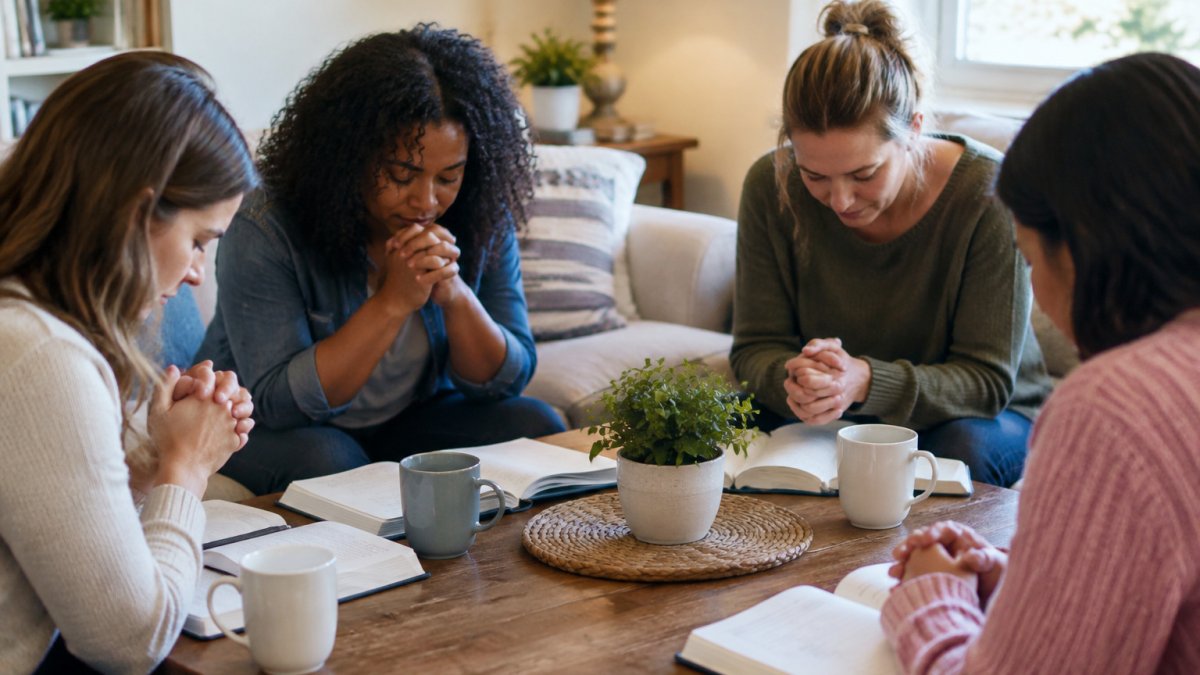
A first meeting should feel short, warm, and easy to follow. Aim for 45 to 60 minutes, and tell everyone the end time up front so no one worries about how long it will run. Here is a ready-to-use agenda you can copy into a notes app.
- Welcome (5 minutes): Thank everyone for coming and read the purpose statement in one sentence.
- Guidelines (5 minutes): Read the agreed guidelines aloud and ask if anyone wants to add one.
- Opening prayer (2 minutes): One person prays a short, simple prayer. A sample is below.
- Sharing requests (15 minutes): Each woman shares one or two requests, or passes.
- Prayer time (15 minutes): Pray aloud for each request, or offer silent prayer, or let women pray spontaneously.
- Closing prayer and next steps (3 minutes): Confirm the next date and place, and ask for one word about how the meeting felt.
Sample opening prayer: "Lord, thank you for bringing us together. Guide our time and help us listen well to one another. Amen."
Discussion prompts for the first meeting. Keep them light and low-pressure:
- What made you want to try a prayer group?
- What is one thing you would like prayer for this month?
- Is there a Scripture or a song that has encouraged you lately?
A low-pressure first prayer activity. Instead of asking everyone to pray aloud, try a one-sentence round. Read a short psalm, such as Psalm 23 or Psalm 121, then invite each woman to pray one sentence based on it, or to say "pass." This gives newcomers a script and a clear stopping point.
Welcoming different comfort levels and traditions. Some women come from traditions where prayers are written and read; others are used to spontaneous prayer. Say plainly at the first meeting that silent prayer, one-sentence prayer, and written prayer are all welcome. If someone prefers not to pray aloud, invite her to write her request on a card and let someone else pray it.
Practical logistics for the first meeting. Decide who hosts and whether hosting will rotate. Ask about childcare needs and accessibility, such as stairs or parking, before you pick a place. Keep refreshments simple, like water, coffee, and a light snack. Choose one communication channel, such as a group text or a shared calendar, and use it for reminders and the next date.
The Prayer Map can be useful here too. Its colorful pages prompt you to write specific thoughts and lists into a prayer map, which can help when you don't know where to start.
Watch out: a first meeting that runs long or includes a long teaching segment often loses the women who were unsure about coming. Keep the prayer time short and end on time.
Small Group Prayer Examples You Can Use Right Away
Sometimes the hardest part is knowing what to say. These small group prayer examples work well in most settings:
- Opening: "Lord, thank you for bringing us together. Guide our time and help us listen well to one another. Amen."
- Requests: "Father, please give strength to Sarah as she cares for her aging mother."
- Closing: "Thank you, God, for hearing us. Help us carry these prayers into our week. Amen."
Short message for prayer meeting ideas can also help. For example, you might share a one-line Scripture reading, invite women to pray a sentence about it, and then close.
Write your favorite examples on a card and keep it in your Bible.
Start Your Prayer Group Online and Keep It Going
If local schedules are tight, you can start a prayer group online. Video calls, group chats, and shared prayer documents all work. Online groups make it easier for women in different time zones or those who are homebound to join.
For an online prayer group, agree on a meeting platform, a set time, and a way to share requests privately. Many groups use a shared document or a group text for prayer requests between meetings.
To keep the group going, check in every few weeks. Ask what is working and what needs to change. Rotate who leads the meeting so everyone feels ownership.
A Year of God's Goodness: A Prayer & Praise Tracker for Women is a prayer and praise tracker where you can record prayer requests, answers to prayer, and praise for God's goodness each day, and see how He worked over the year.

Keep Your Prayer Group At Your Next Meeting
Good groups change over time. At the end of each meeting, ask two quick questions: What helped today? What should we do differently next time?
Follow up on requests during the week with a short text or card. Thoughtful follow-up is one of the simplest ways to help a prayer group last.
Revisit your purpose every few months. If the group has grown or changed, update your guidelines together.
Starting a prayer group with friends takes only one honest invitation and one scheduled meeting. Brandy Clark offers faith-based journals and trackers, including The Prayer Map, that can help your group pray with more focus and encouragement from week to week.
Frequently Asked Questions
How do you begin a prayer group with friends?
Start with a short, personal invitation to a few friends and explain the purpose in one or two sentences. Agree on a regular time and place that works for most people, then hold a first meeting that is short and simple. Open with a brief welcome, a Scripture reading, and a few minutes of shared prayer requests. Close with a prayer and a reminder of the next meeting. Keeping the first gathering low-pressure helps people return, and you can adjust the format as the group settles into a rhythm.
How many people should be in a prayer group?
Most prayer groups work well with between four and eight people. Fewer than four can make it hard for everyone to speak and be heard, while more than eight often means some members stay quiet. A small group also makes it easier to build trust, follow up on prayer requests, and keep the time focused. If your circle grows beyond that size, consider splitting into two groups that meet in different homes or at different times.
How often should a prayer group meet?
Many groups meet weekly or every other week, since a regular rhythm helps members make it a habit. Choose a frequency that your busiest member can realistically keep. Some groups meet monthly for longer sessions, while others add a short check-in text between meetings. Whatever you choose, agree on it at the start and communicate changes early so people can plan around them.
Can you start a prayer group online?
Yes. An online prayer group can use a video call, a shared chat for prayer requests, or both. Set a specific start time and a time limit so people in different time zones and busy schedules know what to expect. Share a simple structure in advance, invite members personally, and follow up with written prayer requests between meetings. Online groups work especially well for friends who live far apart or who cannot meet in person.

0 comments