

Last Updated: October 22, 2026
Quick Summary
To align daily habits with faith, attach one small practice, prayer, Scripture, or journaling, to a moment you already have, like coffee or the car line. Keep it to five minutes, track it simply, and restart small when it slips. Faith habits are a relationship, not a productivity system.
- Anchor prayer to coffee, the school run, or the shower, and aim for five to ten minutes, not thirty.
- Read one short passage a day instead of planning a whole book in a month and quitting by week two.
- Pair the same verse morning and night so repetition moves it into long-term memory.
- Run one habit through five steps: name it, anchor it, shrink it, track it, review it weekly.
- When life changes, change the routine before you change your expectations of yourself.
Table of Contents
- Start With Your Why: Faith Habits That Fit Real Life
- Build a Daily Prayer Routine for Busy Moms
- Create a Simple Bible Study Routine That Sticks
- Use Prayer Journal Prompts to Turn Thoughts Into Conversation
- Try Short Daily Devotional Ideas for Morning and Evening
- A Step-by-Step Method to Align Daily Habits With Faith
- Adapt Your Faith Routine to Your Season of Life
- Frequently Asked Questions
Start With Your Why: Faith Habits That Fit Real Life
Learning how to align daily habits with faith starts with one honest question: what do you want your days to point toward?
The core idea most guides miss: faith habits are a relationship, not a productivity system, and that shift changes how you build them.
Faith habit formation is the practice of attaching small, repeatable spiritual actions to the moments of your day so they become natural rather than forced. You are not chasing a streak.
Three things make a habit stick:
- Specificity: "pray at the kitchen table before I check my phone" beats "pray more."
- Simplicity: five real minutes beats a thirty-minute plan you abandon.
- Support: a journal, a friend, or a set time to return to.
Build a Daily Prayer Routine for Busy Moms
A daily prayer routine for busy moms works best when it is short, anchored to something you already do, and forgiving when it slips. Aim for five to ten minutes, not thirty.
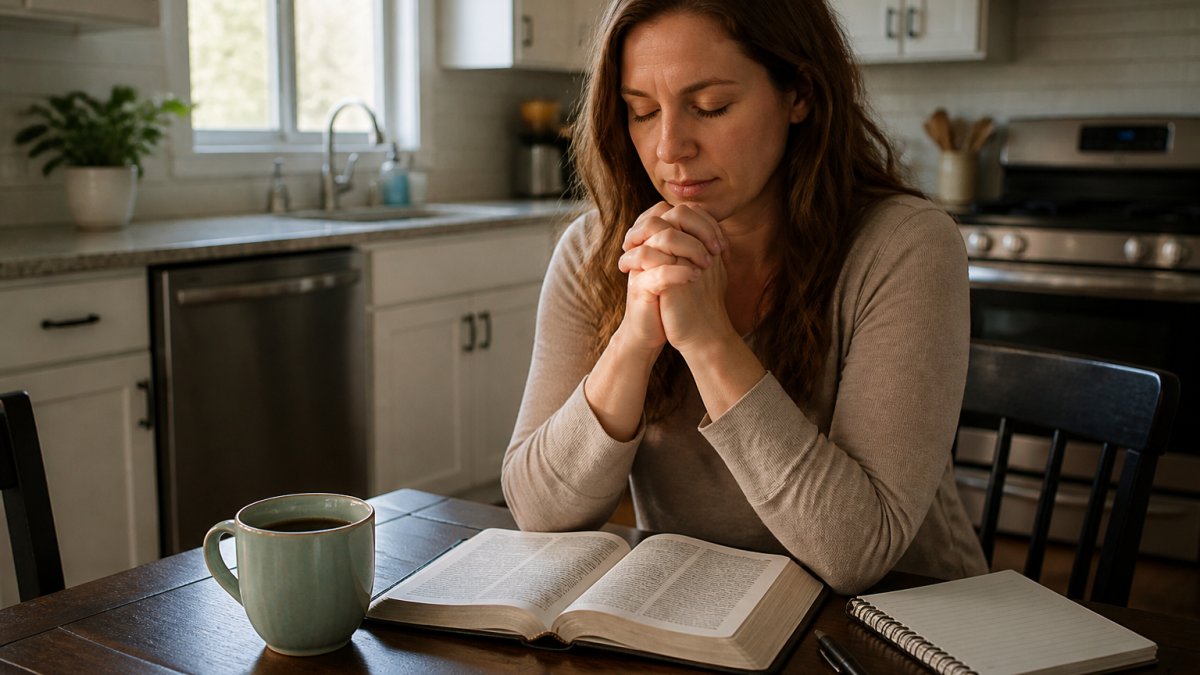
Try this simple structure:
- Anchor it. Attach prayer to coffee, the school run, or the shower.
- Open with one line. "God, here I am."
- Pray for three people. Keep a running list.
- Sit in silence for one minute. No phone.
- Close with thanks. Name one good thing.
Many moms find that mental prayer, simply talking to God in their own words, fits a busy day better than a formal script. The goal is a conversation, not a performance.
Create a Simple Bible Study Routine That Sticks
A simple Bible study routine sticks when the barrier to starting is almost zero. If opening your Bible feels like a project, you will skip it on hard days.
A common mistake is planning to study a whole book in a month and quitting by week two. Start with one short passage a day instead.
Our 5-Minute Bible Study Journal for Moms was built for exactly this.

Here is how to make any study routine last:
- Pick the same time each day, even if it is only five minutes.
- Keep your Bible and journal in one spot.
- Read one passage, not a chapter.
Small and consistent beats long and occasional every time.
Use Prayer Journal Prompts to Turn Thoughts Into Conversation
Prayer journal prompts turn scattered thoughts into focused conversation with God. Writing slows you down enough to notice what you actually feel.
If blank pages intimidate you, try these prompts:
- God, what am I carrying today that I was never meant to hold?
- Where did I see your goodness this week?
- What am I afraid to say out loud?
The Prayer Map: When You Don't Know What to Pray is a good fit for days when words will not come. Each page gives you space to map out specific thoughts and requests, with a spot to record the date so you can look back and see how God answered.
Try Short Daily Devotional Ideas for Morning and Evening
Short daily devotional ideas keep your faith in front of you at both ends of the day. Morning sets direction; evening brings reflection, skip one and the other loses its anchor.
Bible Affirmations Habit Tracker Journal →
A morning devotional works by priming attention, you decide before the day starts what you will notice God doing. An evening devotional works by closing the loop, you look back and name what you saw.
Morning: Prime Attention in Under Five Minutes
Pick one of these and attach it to a cue you already have:
- Before you check your phone: read one verse out loud. One. Not a chapter. The phone can wait ninety seconds.
- While the coffee brews: say a one-sentence morning offering. "God, this day is yours. Show me where you are working." That sentence becomes the lens for the evening review.
- During breakfast cleanup: play one worship song and sing the chorus. Music anchors memory better than a silent read for many people.
The morning practice often fails not from lack of time but from phone proximity. If your Bible is in another room and your phone is on the nightstand, the phone wins. Move the Bible to where you sit with your coffee, and the phone to another room until the verse is read.
Evening: Close the Loop in Two Minutes
Evening reflection is where most habit plans quietly die, because people plan a twenty-minute examen and skip it when tired. Shrink it until it is almost too easy:
- Two-minute examination of conscience: ask two questions. Where did today go well? Where did I fall short? Name one of each. Do not analyze. Name and move on.
- One praise in a tracker: write a single sentence about something good you noticed. Over a month, those sentences become a record you can reread on a hard day.
- Pray over your children by name while they sleep: this takes under a minute per child and is one of the most repeatable evening practices for parents because it requires no setup and no journal.
The A Year of God's Goodness: A Prayer & Praise Tracker for Women pairs scripture and encouraging prayers with space to record requests, answers, and praises. It is built for this morning-and-evening rhythm: a short reading to start, a place to record what you noticed at the end. At year's end you have a written memory of his faithfulness, not a streak you are afraid to break.

When the Pair Breaks Down
- You did the morning but skipped the evening: the morning prime still worked. Do not treat the missed evening as a failure of the whole day. Pick up tomorrow.
- You did the evening but skipped the morning: the review still counts. You noticed God at work even without planning to. That is growth, not a gap.
- You skipped both: restart with the smaller of the two, usually the evening two-minute examen, because it requires no setup and no morning alertness.
A Step-by-Step Method to Align Daily Habits With Faith
To align daily habits with faith, run one small habit through a five-step cycle and repeat it until it feels automatic. Do not start with five habits. Start with one.
| Step | What You Do | Time |
|---|---|---|
| 1. Name it | Choose one practice: prayer, Scripture, or journaling | 5 min |
| 2. Anchor it | Tie it to an existing moment in your day | 5 min |
| 3. Shrink it | Cut it down until it feels almost too easy | 5 min |
| 4. Track it | Mark it done in a journal or tracker | 1 min daily |
| 5. Review it | Check in weekly and adjust what is not working | 10 min weekly |
A physical tracker helps here. The Bible Affirmations Habit Tracker Journal gives you space for daily Bible verses, prayer requests and praises, and up to eight personalized habits, plus monthly reflection prompts.

Troubleshooting When a Habit Slips
A slipped habit is information, not failure. Ask what got in the way before you decide you are bad at this.
- Missed three days? Restart with a smaller version, not a bigger one.
- Too tired at night? Move the habit to the morning.
- Forgot entirely? Your anchor is wrong. Attach it to a stronger cue.
Adapt Your Faith Routine to Your Season of Life
Your faith routine should match your actual season, not an idealized version of your life. A mom with a newborn and a mom with teenagers need different rhythms, and you need to know how to adapt when the season changes unexpectedly, when you are running on empty, and when your routine has collapsed.
Match the Routine to the Season
- Newborn season: one verse and one whispered prayer. That counts. Your body is doing the work of two people; your spirit needs presence, not performance.
- Toddler season: pray out loud so little ears hear it. The prayer is for you and for them at the same time.
- School-age season: use the car line for prayer and worship. The car is a captive audience and a reliable cue.
When the Season Changes Without Warning
The harder problem is not the season you can name but the one that changes on you, a job loss, a diagnosis, a move, a marriage strain, a child in crisis.
Here is the rule that most guides miss: when circumstances change, change the routine before you change your expectations of yourself. Drop to the smallest version that still counts, and name it as the new normal for this season rather than as a temporary failure.
- Disrupted schedule: keep one anchor, drop the rest. If the morning verse survives, the routine survives.
- Caregiving season: pray while you drive, while you wait, while you fold. Unstructured prayer in the gaps is still prayer.
- Grief or crisis: read a Psalm and sit quietly. Let that be enough. Do not add study or journaling until the acute phase passes.
When You Are Struggling With Doubt or Burnout
If you are struggling with doubt or burnout, lower the bar instead of raising it. God is not grading your output, and this is the section most faith-habit guides skip.
- Spiritual dryness: keep the habit but shrink it. One verse, one sentence of prayer. Dryness is a season, not a verdict.
- Doubt: bring the doubt into the practice instead of pausing the practice. Write the question in your journal and leave it there. The Psalms are full of questions; you are in good company.
- Burnout from over-serving: cut the serving before you cut the prayer. Many people burn out on church activity, not on God.
Measure Progress Without Turning Faith Into a Score
Measuring progress matters, but not as a score. Track consistency and gratitude, not perfection. A tracker shows patterns, not your worth.
- Track the day, not the streak. A checkmark says you showed up. A broken streak says nothing about your faith.
- Track gratitude alongside requests. A page of answered prayers is a better motivator than a perfect row of checkmarks.
- Review monthly, not daily. Daily review turns into scorekeeping. A monthly look back shows the pattern without the pressure.
The Bible Affirmations Habit Tracker Journal is built for this approach: daily Bible verses, prayer requests and praises, up to eight personalized habits, and monthly reflection prompts. You set the plan for your season, not a generic template, and the monthly review shows patterns rather than pressuring you into a perfect record.
Frequently Asked Questions
How can busy moms make time for prayer each day?
Start with five minutes, not thirty. A daily prayer routine for busy moms works best when it attaches to something you already do: pray in the car line, during nap time, or while the coffee brews. Keep a journal within reach so you can jot a prayer request and return to it later. Consistency matters more than length. Five focused minutes of conversation with God, repeated daily, builds a habit faster than an hour you manage once a month.
How do I build a consistent Bible-reading habit when my schedule changes?
Anchor your simple Bible study routine to a fixed cue, like the first cup of coffee or the moment the kids are in bed. Keep the passage short: a few verses read slowly beats a chapter skimmed. A guided journal with dated studies removes the decision of what to read next and gives you a place to write what you noticed. If you miss a day, pick up where you left off instead of starting over.
What are simple ways to include faith in a daily routine?
Layer faith onto things you already do. Pray a one-sentence morning offering before your feet hit the floor. Play worship music while you wash dishes. Ask your kids one question about their day and connect it to a verse. Write a prayer journal prompt at bedtime. These small practices align daily habits with faith without adding a separate block of time, and they tend to last because they ride on routines you already keep.
What should I do when I keep falling behind on my faith habits?
Treat a missed day as information, not failure. Ask whether the habit was too big, too vague, or attached to a cue that no longer happens. Shrink it: one verse, one prayer, one line in a journal. Set a reminder on your phone. Then restart the next day without making up lost ground. Grace is part of the practice, not a reward for perfect consistency.
0 comments