

Quick Summary
Alternatives to traditional Sunday school include family Bible study at home, small-group or community models, story-based learning, and children's church during worship. The best fit depends on the children's ages, church size, and how many volunteers are available. Home study can run in ten to fifteen minutes a day, while rotation models need a reliable weekly volunteer team.
- Count children by age band and reliable adult volunteers before choosing a model.
- Family Bible study works best in ten to fifteen minute daily sessions.
- Children's church keeps kids in the worship context and needs a rotating team.
- Pilot one model with one age group for a season before expanding.
- Track participation, biblical understanding, belonging, and family engagement each quarter.
Table of Contents
- Why Parents and Churches Look Beyond Traditional Sunday School
- Comparing Models by Age Group, Church Size, and Staffing
- Family Bible Study for Kids at Home
- Creative Sunday School Ideas That Keep Kids Engaged
- Bible Verse Activities for Children That Stick
- Small-Group, Story-Based, and Children's Church Options
- Costs, Volunteer Workload, and Making the Switch
- Start Your Family's Bible Routine With the Right Activity Books
- Frequently Asked Questions
Why Parents and Churches Look Beyond Traditional Sunday School
Many churches and families are asking whether a single weekly class is enough to build lasting faith in children. Traditional Sunday school remains a common model in many congregations, but it is not the only one, and it does not fit every household or church size. Christian education is a broad field, and the right approach depends on who is teaching, how much time is available, and what the child needs.
Parents often look beyond the classroom because a one-hour session once a week leaves a lot of time unused. Some want the Bible woven into dinner conversations and bedtime routines. Others run small churches where a self-contained classroom simply cannot be staffed. Both groups are looking for alternatives to traditional Sunday school that match their real schedules.
The trade-off is real. A traditional program offers structure, a trained volunteer, and a predictable curriculum. An alternative may offer more flexibility and more family involvement, but it asks more of the adults who run it.
Comparing Models by Age Group, Church Size, and Staffing
The best model depends on three things: the ages of the children, the size of the congregation, and how many volunteers are available. A practical decision framework starts with constraints, not preferences.
| Model | Best Age Group | Church Size | Staffing Need | Main Strength |
|---|---|---|---|---|
| Traditional self-contained classroom | All ages, graded | Medium to large | High, one teacher per class | Structure and predictability |
| Small-group or community group | Mixed ages | Small to medium | Moderate, group leaders | Relationships and discussion |
| Children's church during worship | Ages 3 to 10 | Any size | Moderate, rotating helpers | Keeps kids in worship context |
| Family-led home study | Ages 2 to 10 | Any size | Low, parent-led | Daily faith formation at home |
Work through the framework in this order. First, count the children in each age band and the adults who can reliably serve at least twice a month. Second, decide whether your priority is depth of relationship, breadth of biblical coverage, or family involvement. Third, check the space and time you actually control. A small church with few volunteers may find a graded classroom hard to staff, while a mixed-age small group with a parent-led home component can be more manageable.
Smaller churches may find that combining models works better than copying a large-church program. A single volunteer can lead a mixed-age group with an activity book, while a parent handles devotions at home during the week. Larger churches sometimes run children's church during worship and a midweek small group, using the same volunteers in different roles so no one serves every week.

Watch out: choosing a model because a neighboring church uses it, without matching it to your volunteer count and room schedule, can cause a new format to struggle.
A simple way to test fit is to map each model against four questions: Who teaches? How often? What space is needed? What happens when the teacher is absent? If you cannot answer the fourth question for a model, it is not yet feasible for your congregation.
Family Bible Study for Kids at Home
Home-based learning is one of the most practical alternatives, and it requires the least formal staffing. A parent can set aside ten to fifteen minutes after breakfast or before bed to read a story and complete a short activity together. Family Bible study for kids works best when it is brief, repeated, and tied to a real moment in the day.
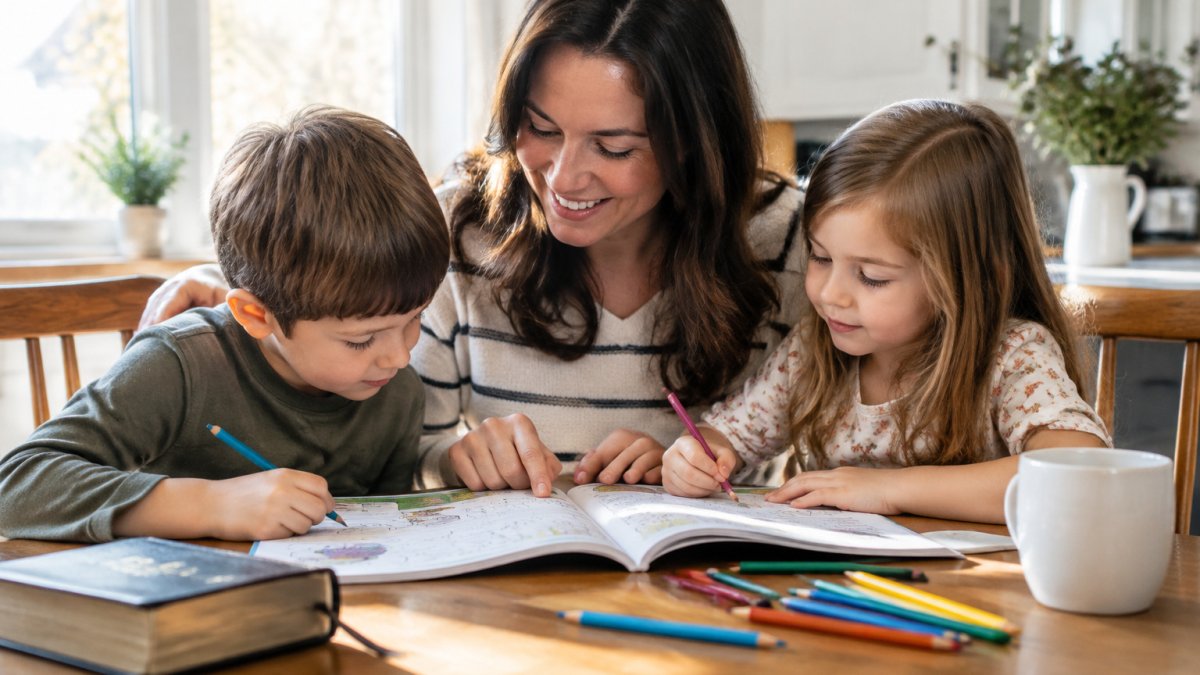
Activity books give the routine a clear starting point. The Know Your Bible Activity Book for Kids at $7.99 uses crosswords, word searches, secret codes, and coloring pages to cover the 66 books of the Bible for children aged 6 to 10. Parents of younger children may prefer the My Bible Stories Activity Book at $9.99, which is designed for ages 3 and up and includes card press-outs and foil stickers.

A common mistake is trying to cover too much in one sitting. Pick one story or one verse per session and let the child finish the activity before moving on.
Creative Sunday School Ideas That Keep Kids Engaged
Engagement drops quickly when children sit still for long periods. Creative options help hold attention without turning the lesson into entertainment. Group coloring, short discussion games, and hands-on crafts all work well in classroom and home settings alike.
A large printed coloring sheet can serve as a group activity. The Faith-Based Bible Stories Coloring Tablecloth at $24.99 measures 36" x 72" and gives a whole table of children room to color Bible scenes together. For discussion, the Would You Rather card game at $9.99 pairs playful questions with Bible characters and events, with the scripture printed on the back of each card.

The point is not novelty for its own sake. Each activity should connect back to the story the children heard.
Price of Bible activity books and materials
Bible Verse Activities for Children That Stick
Memorization can be challenging in many programs. Short, repeated exposure to verses over several weeks is a common approach.
The Coloring Cards Boxed 52 Verses for Kids at $9.99 is built for this purpose. Each card prints a memory verse on the front and a line drawing on the back, and the set covers verses from the ESV, NIV, and NKJV. The cards are listed for ages 5 through 8, so they suit early elementary classes or a family working through one verse per week.
Use the cards as a weekly rhythm: one card at the start of class, a quick recitation at the end, and the card taken home for the week.
Small-Group, Story-Based, and Children's Church Options
Small groups work well when relationships matter more than curriculum depth. Children speak more in a group of four or five, and the adult leader can adjust to each child's pace. Story-based learning, where lessons are built around a narrative rather than a topical outline, suits younger children who think in pictures and sequences.
Each of these models has a distinct implementation pattern. A small-group model typically needs a consistent leader and a simple discussion guide. Story-based learning typically needs a storyteller and a short response activity. Children's church typically needs a rotation schedule and a clear handoff from the worship service.
Transition planning matters as much as the model itself. A common pattern is to pilot one model with one age group for a season, communicate the change to families in advance, and train volunteers on the specific materials and routines before launch.
Evaluation is an area where many churches benefit from a simple plan. A simple framework tracks four things: participation (attendance and retention), biblical understanding (can children retell the story or recall the verse?), belonging (do children and parents report feeling known?), and family engagement (are families using materials at home?).
Some congregations combine all three: a story-based children's church during worship, small-group discussion mid-week, and a family activity at home. Combining models spreads the volunteer load, but it also multiplies the coordination work, so assign one person to own the schedule and materials across all formats.
Watch out: launching a new model without a named coordinator and a written volunteer schedule is the most reliable way to burn out the few adults who said yes.
Costs, Volunteer Workload, and Making the Switch
Costs vary widely depending on the model chosen. A home program may require little beyond one activity book, while a rotation program can require printed materials and room setup. Budget for materials first, then for the time volunteers will spend preparing and teaching each week.
Volunteer workload is often the deciding factor. A traditional class needs one trained teacher each week. A small group needs a leader and a plan for who takes over when the leader is away. Children's church needs a rotating team, and that team must be filled every Sunday.
When switching models, change one thing at a time. Run a pilot with one age group for a season, collect feedback from parents and volunteers, and adjust before expanding. Abrupt changes tend to lose families who valued the old routine.
Start Your Family's Bible Routine With the Right Activity Books
Whether you teach at church or at home, the right materials make consistency easier. Choose an activity book that matches your child's age and your time commitment. For children aged 6 to 10 who are ready to learn book-by-book structure, the Know Your Bible Activity Book is a strong starting point. For younger children, the picture-heavy My Bible Stories book is easier to start with.
A practical way to begin is small: one book, one verse card set, and fifteen minutes a day. Once that routine holds for a few weeks, add a discussion card game or a larger coloring sheet for family time. Brandy Clark offers faith-based activity books and cards that can support this kind of family routine, so you can start at home and expand as your children grow.
Frequently Asked Questions
Are alternatives to traditional Sunday school effective?
Effectiveness depends on consistency and adult involvement. Home-based study and small groups often work well when a parent or leader follows a regular routine. Results are hard to measure precisely, so track engagement and recall over several months.
What age is best for Bible activity books?
Activity books are typically designed for specific age ranges. Check each product's listed ages before you buy. Brandy Clark's Know Your Bible book targets ages 6 to 10, while its My Bible Stories book is listed for ages 3 and up.
How much time does family Bible study need?
Ten to fifteen minutes a day is a practical starting point for young children. Longer sessions can work for older kids who can focus for more time.
Frequently Asked Questions
What is the best curriculum for Sunday school?
No single curriculum fits every church. The best choice depends on the age range you teach, how many volunteers you have, and whether your goal is Bible literacy, discipleship, or family involvement. Many teachers combine a structured lesson plan with hands-on activities such as coloring, puzzles, and memory verse games. Look for materials that match each age group, include clear lesson aims, and need little preparation time from volunteers. Test one option for a few months before committing to a full year, and ask teachers and parents what kids actually remember.
How can parents teach the Bible at home?
Parents can start with short, consistent routines rather than long lessons. Reading one Bible story at breakfast or bedtime, completing a page of a Bible activity book together, or playing a family game built around a Bible character all build familiarity with Scripture. Activity books listed for ages 3 and up, such as the My Bible Stories Activity Book at $9.99, can make these sessions feel like play. Ten to fifteen minutes a few times a week is enough to build a habit that lasts.
How do small groups work as an alternative to Sunday school?
Small groups meet in homes or other shared spaces, usually for a discussion-based study led by a host or leader. Children may join a family group where parents and kids learn together, or a separate kids' group with a leader. Small groups suit churches with limited space and volunteers, and they encourage relationships across ages. The tradeoff is that they need strong leaders and consistent attendance to work well, so plan for training and clear expectations.
How do I choose a Bible curriculum for children of different ages?
Start by grouping children by developmental stage, since a four-year-old and a ten-year-old need different levels of reading and reasoning. Choose resources labeled for specific age ranges, or use flexible materials that offer both simple and more advanced activities. The Know Your Bible Activity Book for Kids, starting at $7.99, is designed for children roughly six to ten, while the coloring cards for ages 5 through 8 at $9.99 suit younger readers working on memory verses. Matching materials to age keeps every child engaged without frustration.

0 comments